Here are some pictures of the figure I did for Bohogirl--my version of Sir William Wallace as a Scotty dog.
Mar 11, 2011
Sir William Wallace--the Scotty
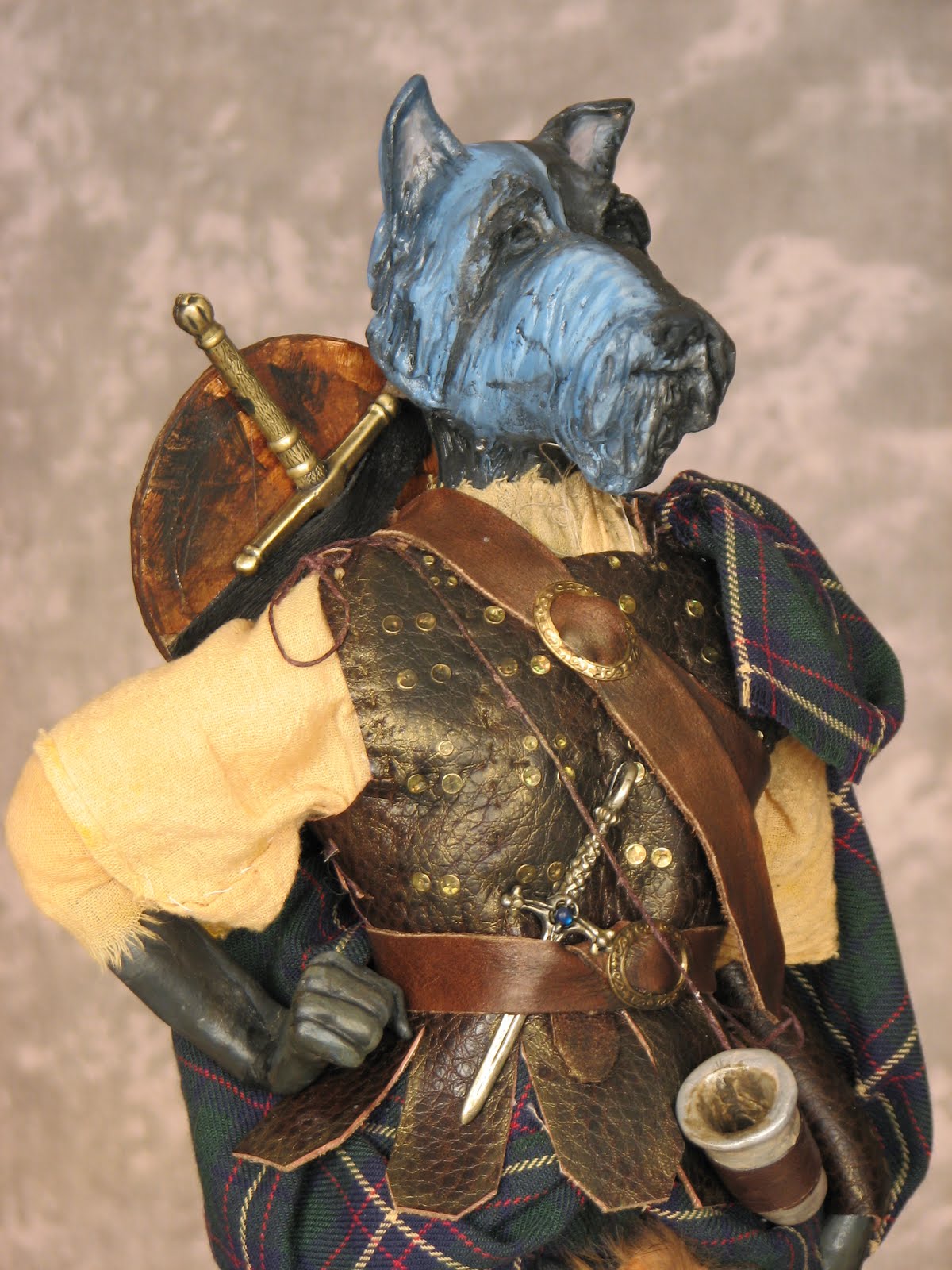
Here are some pictures of the figure I did for Bohogirl--my version of Sir William Wallace as a Scotty dog.
Dec 10, 2010
Duncan MacPherson
Here are some photos of the dog I just finished on commission, using the client's family tartan: the ancient MacPherson. The client hasn't seen him yet ... Duncan gets delivered tomorrow ....


Dec 4, 2010
Dogs in Kilts.
Well, dang. It's been a long time since I posted on the old blog! But I'm still here, still working ... although, between writing the books and looking after the puppy, I haven't had much time to work on my art. But (and this is a good but) ... I'm back at it and taking things in a slightly new direction. I'm doing dogs! Well, at the moment I'm doing Westies--inspired by my Robert and a conversation I had with the wonderful lady who grooms him (hi, Gilda).
Just before Thanksgiving, I did one (Capt. Hamish MacTavish) for the annual fundraising banquet of the Westie Club of Greater Atlanta. (He's the one in the busby hat--the big black bearskin hat like the Palace Guards in England wear.) After the banquet, we drove up to Asheville, stopping to take a little walk and do a little poking around. I stopped in a couple of places and got to talking (rare for me, since I'm a terrible introvert) ... but I sent them some photos as follow-up yesterday and guess what? At least one of them wants to carry my dogs--most notably Jackie at Boho Girl Designs, who makes exquisite beaded jewelry. Jackie has a Scottie named Sir William Wallace (Wally for short) ... so how could I not be charmed? I will probably make a Scottie and a Westie (or two) for her to carry on consignment. Her shop, by the way, if you're driving out that way, is located in The Main Street Shops, 44 Chevy Drive, HWY 515, Blairsvilee, Ga. 30582. Or ... you can visit her website at www.bohogirldesigns.com.
Anyhoo ... here are some pictures of my Westie Highlanders ... all hand-sculpted and one-of-a-kind. I will do commissions in your own clan tartan. The cost runs between $400 and $500, plus the cost of acquiring the tartan.

Just before Thanksgiving, I did one (Capt. Hamish MacTavish) for the annual fundraising banquet of the Westie Club of Greater Atlanta. (He's the one in the busby hat--the big black bearskin hat like the Palace Guards in England wear.) After the banquet, we drove up to Asheville, stopping to take a little walk and do a little poking around. I stopped in a couple of places and got to talking (rare for me, since I'm a terrible introvert) ... but I sent them some photos as follow-up yesterday and guess what? At least one of them wants to carry my dogs--most notably Jackie at Boho Girl Designs, who makes exquisite beaded jewelry. Jackie has a Scottie named Sir William Wallace (Wally for short) ... so how could I not be charmed? I will probably make a Scottie and a Westie (or two) for her to carry on consignment. Her shop, by the way, if you're driving out that way, is located in The Main Street Shops, 44 Chevy Drive, HWY 515, Blairsvilee, Ga. 30582. Or ... you can visit her website at www.bohogirldesigns.com.
Anyhoo ... here are some pictures of my Westie Highlanders ... all hand-sculpted and one-of-a-kind. I will do commissions in your own clan tartan. The cost runs between $400 and $500, plus the cost of acquiring the tartan.

May 10, 2010
Mother's Day
Yesterday was so beautiful, I felt like going for a drive. So we packed up the puppy and headed south toward Covington, the quaint little town where they film the television series Vampire Diaries. It being Sunday in the Bible belt, nothing was open save a few restaurants and an ice-cream parlor. We indulged, of course. Here's a picture of us in the park on the square, overlooking the Mystic Grille--where all the kids hang out on the show. In reality, it's a CPA's office window-dressed as a set. I was still pretty excited to see it there.Nina
May 1, 2010
Guess who's a new mommy?


Here's a couple pictures of my new adopted son, Sir Robert Raeburn of Highland Glen. He's a West Highland White Terrier. His daddy's a champion named Caymus of Highland Glen. Our Robby's about fourteen weeks and has been with us for about three weeks now. These pictures were taken on a picnic/hike about two weeks ago at Amicalola Falls. Isn't he sweet?
Guess who's a grandma?


I'm a grandmother, as of April 26! Here are pictures of my new little grandson, Reid Henry Slayton. Isn't he adorable? The big people in the photos are my daughter, Marisa, and her husband, Jake. Aren't they a beautiful family?
Feb 1, 2010
Coming up for air ...
Well, I have finally finished my first novel, HEART OF THE BEAST, to my agent's satisfaction and it is now ready to go out to publishers for review. Below is the "sales copy" I created to describe the book for those purposes. It's supposed to hook you so you'll want to read the book ... Does it do the trick?
Robert Hamilton: Smoldering, sensitive, inscrutable … and reclusive. He’s imprisoned by a haunting past: every girl he’s ever loved has been brutally murdered. And he just got a sign that it’s about to happen again.
Katrina Bentley: Bright, striking, frank … and distrustful. An English literature major at London University, she prefers books to flesh-and-blood men.
He’s writing a novel about a centuries-old vampire while she’s writing her thesis on the evolution of vampires in literature. When the two lost souls meet, they’re guarded, taciturn, and surly toward each other … but only at first. With each chance encounter, sparks fly, passions flare, and tension builds. With each chance encounter, she opens more of her heart while he struggles to conceal his dark truth. When he realizes he’s let things go too far—and that he’s put her in mortal danger—he breaks his own heart to protect her. But can he stop the past from repeating itself?
Sexy, smart, and suspenseful, HEART OF THE BEAST tells the story of The Vampire, then and now, and of a love powerful enough to reach across the abyss of time ... and death.
I'm still working on BLOODLUST, the sequel novel, but it's far enough along that my agent wants to try to sell then together. Fingers crossed!
In the world of dolls, I've got to get Alexander Hamilton ready for the national DAR contest. I made him a new silk banyan and waistcoat several weeks ago ... but still need to write a paragraph describing the entry and how it relates to the contest theme, and take some good pictures.
As ever, I've been refining my Robert Hamilton figure ... he got real tartan socks, leather shoes (that do not come off) and a little skian dugh knife to stick in the top of his hose. Robert wears his kilt quite a bit in the second book, being back in Scotland and all.
I've also made some dolls of fairies from the second book. I'll have to post pictures of them one of these days.
Nina
Robert Hamilton: Smoldering, sensitive, inscrutable … and reclusive. He’s imprisoned by a haunting past: every girl he’s ever loved has been brutally murdered. And he just got a sign that it’s about to happen again.
Katrina Bentley: Bright, striking, frank … and distrustful. An English literature major at London University, she prefers books to flesh-and-blood men.
He’s writing a novel about a centuries-old vampire while she’s writing her thesis on the evolution of vampires in literature. When the two lost souls meet, they’re guarded, taciturn, and surly toward each other … but only at first. With each chance encounter, sparks fly, passions flare, and tension builds. With each chance encounter, she opens more of her heart while he struggles to conceal his dark truth. When he realizes he’s let things go too far—and that he’s put her in mortal danger—he breaks his own heart to protect her. But can he stop the past from repeating itself?
Sexy, smart, and suspenseful, HEART OF THE BEAST tells the story of The Vampire, then and now, and of a love powerful enough to reach across the abyss of time ... and death.
I'm still working on BLOODLUST, the sequel novel, but it's far enough along that my agent wants to try to sell then together. Fingers crossed!
In the world of dolls, I've got to get Alexander Hamilton ready for the national DAR contest. I made him a new silk banyan and waistcoat several weeks ago ... but still need to write a paragraph describing the entry and how it relates to the contest theme, and take some good pictures.
As ever, I've been refining my Robert Hamilton figure ... he got real tartan socks, leather shoes (that do not come off) and a little skian dugh knife to stick in the top of his hose. Robert wears his kilt quite a bit in the second book, being back in Scotland and all.
I've also made some dolls of fairies from the second book. I'll have to post pictures of them one of these days.
Nina
Dec 14, 2009
Anne Boleyn, etc.


Finally finished the commission of Anne Boleyn. The customer wanted her in this particular costume ... which proved challenging in several ways ... but she came out well in the end, I think. What do you think?
Nov 21, 2009
Deleted Scenes
I thought I might just post a few of the deleted scenes from Heart of the Beast. These were cut by my agent primarily because she felt they disrupted the plot action too much. I wrote them to address the larger theme of the book, which explored the human capacity for good and evil. The following was one of my favorite scenes in the book. Sigh. Oh well. Maybe I can use it in a future novel. Anyway, enjoy! (FYI: Robert is the vampire's name.)
"The warbling wail of the warning sirens came first. Soon, a chorus of droning, sputtering engines joined in, the sound of approaching planes, descending like a swarm of ravenous locusts. Then percussion punctuated the cacophony: whistling bombs, booming blasts, and the sharp cracks of shattering glass, bricks, and mortar. The ground violently quaked. Finally, there arose the sounds of human suffering in the street below. Whimpers, screams, sobs, and moans.
“Every few minutes, new waves of planes buzzed overhead like an agitated hive of bees. The gunfire popped and spit intermittently. Some shots were near and sharp, others distant and muffled. The bombs fell in batches, flashing brilliantly when they hit before shrinking to pinpoints of dazzling phosphorescent white. Now and then, leaping tongues of searing yellow would burst out of the white to declare that yet another structure had ignited in flames.
“With each batch of bombs, the window before me rattled menacingly and the floorboards violently shook under my feet. I could smell the acrid smoke and hear the crackle of the nearest blazes. The whole city, it appeared, was burning. What was left of it, anyway. The night sky glowed a brilliant orange red as flames leapt hundreds of feet into the air. Plumes of ghoulish smoke rose into a sickly pink cloud that hovered menacingly overhead and stretched as far as the eye could see. In the distance, I could just make out the shadowy silhouette of the great dome of St. Paul’s Cathedral illuminated by a halo of fire. Everywhere else, I saw only the shifting shadows of death, destruction, and despair.
“When the sirens finally stopped, I looked back through the window to the street below. In the warm, flickering glow of the fires, I could make out throngs of frightened humans now pouring out of the shelters, stumbling over the rubble of fallen buildings, making their way back to their homes—hoping and praying that their homes were still there for them to go back to. Most would not be. The city had been decimated by the unrelenting blasts. More than one million homes had already been destroyed. I was quite certain that it was only a matter of time before one of the bombs hit our residence, destroying the house and probably me, Fanny, and Edmund along with it. ‘The worst is over,’ I told my friends. ‘For now.’ I looked despondently from the window to the faces of my friends. I saw in their expressions the same relief I felt inside, knowing that we had survived another evening of the Blitz.
“For forty consecutive nights, the Germans had been bombarding London and her civilian inhabitants. The death toll had already reached forty thousand. And it was still climbing. I knew all too well that tonight’s attack would leave thousands more dead or homeless. At least I and the Mansfields were not among them. Not yet anyway.
“It all started at around four o’clock in the afternoon on September 7, 1940. The appearance of hundreds of German bombers and fighter planes in the skies over London heralded a tactical shift in Adolf Hitler’s attempt to bring Great Britain to its knees. For two months prior, in preparation for a planned invasion of the British Isles, the Luftwaffe targeted British airfields and radar stations for destruction. When the invasion plan was abandoned, Hitler hatched a scheme to destroy London, hoping the attacks would both demoralize Britain’s people and assuage her military prowess.
“This bombing spree went on day and night for fifty-seven consecutive days. Londoners sought shelter wherever they could find it—many fleeing to the Underground stations that sheltered as many as 170,000 people during the night. Thousands of children were put on trains and sent into the countryside for protection.
“When the bombing started, we were living in Soho. With the war on, we lacked the financial resources to remain in the countryside. But because the house had no cellar, we had to make a potentially life-or-death choice: wait out the attacks in our dwelling unprotected or go to a public shelter and wait amidst a crush of human flesh and blood.
“We had much to consider, discuss, and debate. Were vampires impervious to bombs and fire? What would an incendiary blast do to our skin if our clothes caught fire? Would we suffer agonizing pain? (I was sure we would. I have burnt myself on cigarette embers and it was extremely painful.) If we caught fire, would we scar? Would we incinerate? There was no handbook, no survival manual, for vampires who found themselves trapped in a war zone. Collectively, we came to a decision. We would not, could not, go into the bomb shelters with the humans. The mass of flesh, the smell of blood, could not be borne. We would not risk the lives of innocent men, women, and children to save our own.”
Robert looked at her face. She was staring at him raptly with an expression of shocked disbelief. He cast his eyes down at the floor before continuing.
“During my years as a vampire, I have pondered many times the nature of good and evil in the world. At one point in my life, I was so consumed by these contemplations that I enrolled in philosophy courses at Christ’s College in Cambridge.”
When he saw her finger go up, he stopped talking.
“Just how many degrees do you have?”
“Somewhere near a dozen,” he replied with a frown.
The vampire nervously cleared his throat before he said, “I have come to see good and evil not as absolutes, but as two opposing forces on a spectrum that encompasses every conceivable moral act of which human beings were capable. Every degree of goodness. Every shade of evil.”
She eyed him quizzically.
“And what do you consider the apex of goodness?”
“It is extremely difficult to define as a constellation of positive moral characteristics,” he replied dryly. “It is far easier to choose from human history a person who exemplifies those qualities. Thus, at the pinnacle of the scale, I would place Jesus of Nazareth. Jesus is the only man I know of who completely eschewed the ego—the fear-based part of us that fuels our evil tendencies. By doing so, Jesus attained oneness with God, a perfect Christ state, while still in human form.”
“And the pinnacle of evil?”
“Adolf Hitler,” he replied gruffly. He paused a moment before adding, “The hateful depths of Hitler’s heart were utterly inconceivable to me. But it was even harder for me to fathom that Hitler was only the mastermind—that he was not perpetrating this and worse unspeakable evils on his own. Others were willingly carrying out his orders.”
He thought about what Albert Einstein had said: “The world is a dangerous place, not because of those who do evil, but because of those who look on and do nothing.” Then he turned his woeful eyes to Kat, who was still watching him with rapt attention.
“Are you familiar with the Milgram experiment?”
She shook her head.
“It was a series of social psychology trials designed to measure how willing humans were to carry out orders that inflict pain and conflict with their consciences,” he explained. “Yale University psychologist Stanley Milgram began the tests in July 1961, three months after the start of the trial of Nazi War criminal Adolf Eichmann in Jerusalem. Milgram devised the experiments to answer this question: ‘Could it be that Eichmann and his million accomplices in the Holocaust were just following orders? Could we call them all accomplices?’ Milgram summarized the experiment in a 1974 article, observing that when conscience is pitted against authority, authority wins out more often than not.”
“How did he set up the experiment?”
Robert took a deep steadying breath before explaining that, during the study, the “teacher”—the subject of the experiment—was directed by a man in a white lab coat to ask a “learner” a series of questions. When the “learner” gave the wrong answer, the “teacher” was told to administer an electrical shock. With each wrong answer, the voltage increased. Both the “teacher” and the “learner” were led to believe that they were participating in an experiment on memory and learning.
Although the “learner” was an actor who didn’t receive actual shocks, the “teacher” believed the shocks were real. After a number of voltage increases, the “learner” banged on the wall that separated him from the subject. After several times banging on the wall, screaming, and complaining about his heart condition, all responses by the “learner” would cease.
“At that point, many people indicated their desire to stop the experiment and check on the learner. Some test subjects paused at one-hundred-and-thirty-five volts and began to question the purpose of the experiment. But most continued after being assured that they would not be held responsible. If at any time the subject indicated his desire to halt the experiment, he was given a succession of verbal prods by the experimenter, in this order: 1) Please continue; 2) the experiment requires that you continue; 3) it is absolutely essential that you continue; 4) you have no other choice, you must go on.
“If the subject still wished to stop after all four successive verbal prods, the experiment was halted. Otherwise, it was stopped only after the subject gave the maximum 450-volt shock three times in a row.
“In the first set of experiments, 65 percent of participants administered the experiment’s final deadly shock, though many were very uncomfortable doing so. Only one participant steadfastly refused to administer shocks before the 300-volt level.
“The experiment has been replicated at different times, in different countries, and different settings. The results remained remarkably—and frighteningly—the same: When directed by authority, 61 to 66 percent inflicted the fatal voltage.”
Robert remained very still, staring at the floor while trying to clear his head. Finally, he turned to her and asked, “Are you familiar with the poet Tony Harrison?”
She nodded.
“Do you know his poem titled Shrapnel?”
“I don’t think so.”
“As a child, the poet was sheltering in a cellar in Beeston the night the Germans ordered an all-out air assault on Leeds. More bombs were dropped that night on Beeston than any other part of the city. Yet, miraculously, Beeston sustained the least amount of damage. Most of the bombs landed in an uninhabited park across the street from the targeted row houses. In his poem, Harrison speculates that the bombardier deliberately defied orders in an act of compassion toward the people below.”
Over the hard lump in his throat, he recited for her an excerpt from the poem:
“And but for him, I thought, I could have died.
So now I celebrate my narrow squeak,
the unseen foe who spared our street in Leeds,
and I survived to go on to learn Greek
and find more truth in tragedy than creeds.
I stroke my shrapnel and I celebrate,
surviving without God until today,
where on my desk my shrapnel paperweight
stops this flapping poem being blown away.
A flicker of faith in man grew from that raid
where this shrapnel that I'm stroking now comes
from,
when a German had strict orders but obeyed
some better, deeper instinct not to bomb
the houses down below and be humane.”
"The warbling wail of the warning sirens came first. Soon, a chorus of droning, sputtering engines joined in, the sound of approaching planes, descending like a swarm of ravenous locusts. Then percussion punctuated the cacophony: whistling bombs, booming blasts, and the sharp cracks of shattering glass, bricks, and mortar. The ground violently quaked. Finally, there arose the sounds of human suffering in the street below. Whimpers, screams, sobs, and moans.
“Every few minutes, new waves of planes buzzed overhead like an agitated hive of bees. The gunfire popped and spit intermittently. Some shots were near and sharp, others distant and muffled. The bombs fell in batches, flashing brilliantly when they hit before shrinking to pinpoints of dazzling phosphorescent white. Now and then, leaping tongues of searing yellow would burst out of the white to declare that yet another structure had ignited in flames.
“With each batch of bombs, the window before me rattled menacingly and the floorboards violently shook under my feet. I could smell the acrid smoke and hear the crackle of the nearest blazes. The whole city, it appeared, was burning. What was left of it, anyway. The night sky glowed a brilliant orange red as flames leapt hundreds of feet into the air. Plumes of ghoulish smoke rose into a sickly pink cloud that hovered menacingly overhead and stretched as far as the eye could see. In the distance, I could just make out the shadowy silhouette of the great dome of St. Paul’s Cathedral illuminated by a halo of fire. Everywhere else, I saw only the shifting shadows of death, destruction, and despair.
“When the sirens finally stopped, I looked back through the window to the street below. In the warm, flickering glow of the fires, I could make out throngs of frightened humans now pouring out of the shelters, stumbling over the rubble of fallen buildings, making their way back to their homes—hoping and praying that their homes were still there for them to go back to. Most would not be. The city had been decimated by the unrelenting blasts. More than one million homes had already been destroyed. I was quite certain that it was only a matter of time before one of the bombs hit our residence, destroying the house and probably me, Fanny, and Edmund along with it. ‘The worst is over,’ I told my friends. ‘For now.’ I looked despondently from the window to the faces of my friends. I saw in their expressions the same relief I felt inside, knowing that we had survived another evening of the Blitz.
“For forty consecutive nights, the Germans had been bombarding London and her civilian inhabitants. The death toll had already reached forty thousand. And it was still climbing. I knew all too well that tonight’s attack would leave thousands more dead or homeless. At least I and the Mansfields were not among them. Not yet anyway.
“It all started at around four o’clock in the afternoon on September 7, 1940. The appearance of hundreds of German bombers and fighter planes in the skies over London heralded a tactical shift in Adolf Hitler’s attempt to bring Great Britain to its knees. For two months prior, in preparation for a planned invasion of the British Isles, the Luftwaffe targeted British airfields and radar stations for destruction. When the invasion plan was abandoned, Hitler hatched a scheme to destroy London, hoping the attacks would both demoralize Britain’s people and assuage her military prowess.
“This bombing spree went on day and night for fifty-seven consecutive days. Londoners sought shelter wherever they could find it—many fleeing to the Underground stations that sheltered as many as 170,000 people during the night. Thousands of children were put on trains and sent into the countryside for protection.
“When the bombing started, we were living in Soho. With the war on, we lacked the financial resources to remain in the countryside. But because the house had no cellar, we had to make a potentially life-or-death choice: wait out the attacks in our dwelling unprotected or go to a public shelter and wait amidst a crush of human flesh and blood.
“We had much to consider, discuss, and debate. Were vampires impervious to bombs and fire? What would an incendiary blast do to our skin if our clothes caught fire? Would we suffer agonizing pain? (I was sure we would. I have burnt myself on cigarette embers and it was extremely painful.) If we caught fire, would we scar? Would we incinerate? There was no handbook, no survival manual, for vampires who found themselves trapped in a war zone. Collectively, we came to a decision. We would not, could not, go into the bomb shelters with the humans. The mass of flesh, the smell of blood, could not be borne. We would not risk the lives of innocent men, women, and children to save our own.”
Robert looked at her face. She was staring at him raptly with an expression of shocked disbelief. He cast his eyes down at the floor before continuing.
“During my years as a vampire, I have pondered many times the nature of good and evil in the world. At one point in my life, I was so consumed by these contemplations that I enrolled in philosophy courses at Christ’s College in Cambridge.”
When he saw her finger go up, he stopped talking.
“Just how many degrees do you have?”
“Somewhere near a dozen,” he replied with a frown.
The vampire nervously cleared his throat before he said, “I have come to see good and evil not as absolutes, but as two opposing forces on a spectrum that encompasses every conceivable moral act of which human beings were capable. Every degree of goodness. Every shade of evil.”
She eyed him quizzically.
“And what do you consider the apex of goodness?”
“It is extremely difficult to define as a constellation of positive moral characteristics,” he replied dryly. “It is far easier to choose from human history a person who exemplifies those qualities. Thus, at the pinnacle of the scale, I would place Jesus of Nazareth. Jesus is the only man I know of who completely eschewed the ego—the fear-based part of us that fuels our evil tendencies. By doing so, Jesus attained oneness with God, a perfect Christ state, while still in human form.”
“And the pinnacle of evil?”
“Adolf Hitler,” he replied gruffly. He paused a moment before adding, “The hateful depths of Hitler’s heart were utterly inconceivable to me. But it was even harder for me to fathom that Hitler was only the mastermind—that he was not perpetrating this and worse unspeakable evils on his own. Others were willingly carrying out his orders.”
He thought about what Albert Einstein had said: “The world is a dangerous place, not because of those who do evil, but because of those who look on and do nothing.” Then he turned his woeful eyes to Kat, who was still watching him with rapt attention.
“Are you familiar with the Milgram experiment?”
She shook her head.
“It was a series of social psychology trials designed to measure how willing humans were to carry out orders that inflict pain and conflict with their consciences,” he explained. “Yale University psychologist Stanley Milgram began the tests in July 1961, three months after the start of the trial of Nazi War criminal Adolf Eichmann in Jerusalem. Milgram devised the experiments to answer this question: ‘Could it be that Eichmann and his million accomplices in the Holocaust were just following orders? Could we call them all accomplices?’ Milgram summarized the experiment in a 1974 article, observing that when conscience is pitted against authority, authority wins out more often than not.”
“How did he set up the experiment?”
Robert took a deep steadying breath before explaining that, during the study, the “teacher”—the subject of the experiment—was directed by a man in a white lab coat to ask a “learner” a series of questions. When the “learner” gave the wrong answer, the “teacher” was told to administer an electrical shock. With each wrong answer, the voltage increased. Both the “teacher” and the “learner” were led to believe that they were participating in an experiment on memory and learning.
Although the “learner” was an actor who didn’t receive actual shocks, the “teacher” believed the shocks were real. After a number of voltage increases, the “learner” banged on the wall that separated him from the subject. After several times banging on the wall, screaming, and complaining about his heart condition, all responses by the “learner” would cease.
“At that point, many people indicated their desire to stop the experiment and check on the learner. Some test subjects paused at one-hundred-and-thirty-five volts and began to question the purpose of the experiment. But most continued after being assured that they would not be held responsible. If at any time the subject indicated his desire to halt the experiment, he was given a succession of verbal prods by the experimenter, in this order: 1) Please continue; 2) the experiment requires that you continue; 3) it is absolutely essential that you continue; 4) you have no other choice, you must go on.
“If the subject still wished to stop after all four successive verbal prods, the experiment was halted. Otherwise, it was stopped only after the subject gave the maximum 450-volt shock three times in a row.
“In the first set of experiments, 65 percent of participants administered the experiment’s final deadly shock, though many were very uncomfortable doing so. Only one participant steadfastly refused to administer shocks before the 300-volt level.
“The experiment has been replicated at different times, in different countries, and different settings. The results remained remarkably—and frighteningly—the same: When directed by authority, 61 to 66 percent inflicted the fatal voltage.”
Robert remained very still, staring at the floor while trying to clear his head. Finally, he turned to her and asked, “Are you familiar with the poet Tony Harrison?”
She nodded.
“Do you know his poem titled Shrapnel?”
“I don’t think so.”
“As a child, the poet was sheltering in a cellar in Beeston the night the Germans ordered an all-out air assault on Leeds. More bombs were dropped that night on Beeston than any other part of the city. Yet, miraculously, Beeston sustained the least amount of damage. Most of the bombs landed in an uninhabited park across the street from the targeted row houses. In his poem, Harrison speculates that the bombardier deliberately defied orders in an act of compassion toward the people below.”
Over the hard lump in his throat, he recited for her an excerpt from the poem:
“And but for him, I thought, I could have died.
So now I celebrate my narrow squeak,
the unseen foe who spared our street in Leeds,
and I survived to go on to learn Greek
and find more truth in tragedy than creeds.
I stroke my shrapnel and I celebrate,
surviving without God until today,
where on my desk my shrapnel paperweight
stops this flapping poem being blown away.
A flicker of faith in man grew from that raid
where this shrapnel that I'm stroking now comes
from,
when a German had strict orders but obeyed
some better, deeper instinct not to bomb
the houses down below and be humane.”
Nov 20, 2009
Taking a breath ...
I've finally finished round one of rewriting on Heart of the Beast, my first novel, with my fabulous new agent. She'll be reading it over the Thanksgiving holiday and I'm waiting with bated breath (tired cliche) for her feedback.
Speaking of Thanksgiving ... I will be cooking the feast this year as my dear sister and family are off to Charlottesville, Va., and Washington, D.C. for the break.
How does this sound?
Turkey (of course, being a traditionalist -- and no deep-fat fryers!)
Cranberry apple relish
Apple and sausage stuffing baked in acorn squash bowls
mashed potatoes with gravy
my husband's sweet potato casserole (it's not the orange mush with the marshmallows on top; he uses the Ruth Chris recipe--it's to die for)
pumpkin pie (home made, not store bought)
What is everybody else planning to make? Any favorites? I usually do a wild rice stuffing in the bird with dried fruit and nuts ... but thought I'd try something different this year. Still debating on whether or not to do a green vegetable. Seems like there will be enough squash, though, to take care of the veg requirements.
Nina
Speaking of Thanksgiving ... I will be cooking the feast this year as my dear sister and family are off to Charlottesville, Va., and Washington, D.C. for the break.
How does this sound?
Turkey (of course, being a traditionalist -- and no deep-fat fryers!)
Cranberry apple relish
Apple and sausage stuffing baked in acorn squash bowls
mashed potatoes with gravy
my husband's sweet potato casserole (it's not the orange mush with the marshmallows on top; he uses the Ruth Chris recipe--it's to die for)
pumpkin pie (home made, not store bought)
What is everybody else planning to make? Any favorites? I usually do a wild rice stuffing in the bird with dried fruit and nuts ... but thought I'd try something different this year. Still debating on whether or not to do a green vegetable. Seems like there will be enough squash, though, to take care of the veg requirements.
Nina
Subscribe to:
Posts (Atom)


